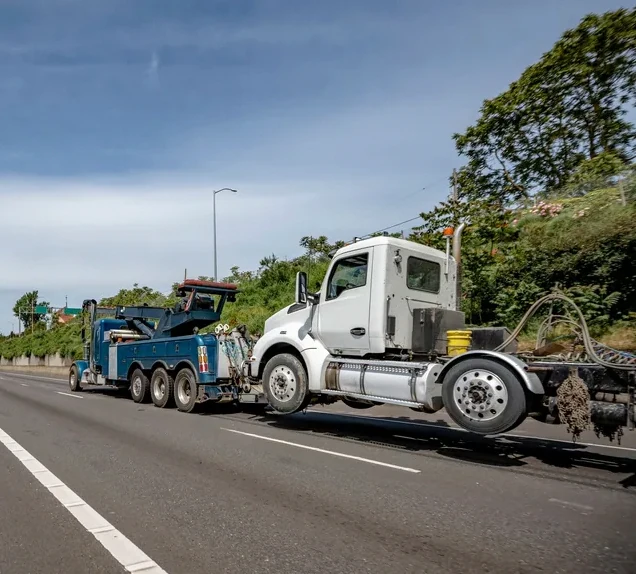
What is Heavy Duty Towing and how does it work?
Heavy duty towing is the specialized recovery and transport of large vehicles and equipment like dump trucks, tractor-trailers, and construction machinery. It uses heavy wreckers, lowboys, and rotators to handle loads over 10,000 pounds safely.
Think of heavy duty towing as the big brother of the standard tow truck you see pulling a sedan. In Birmingham, you see these rigs on I-65 or I-20 when a semi breaks down or a dump truck gets stuck on a job site. The trucks themselves are built differently: a typical medium-duty wrecker might lift 15 to 25 tons, while a heavy duty rotator can handle 50 tons or more. That's the difference between towing a pickup and pulling a fully loaded concrete mixer out of a ditch.
The equipment matters because the stakes are higher. A broken down semi on the Red Mountain Expressway during rush hour isn't just an inconvenience. It can shut down a lane for hours, cost a trucking company thousands in lost time, and create a safety hazard for other drivers. Heavy duty towing companies in Birmingham keep specialized gear like air compressors for brake releases, portable axle locks, and heavy chains rated for 30,000 pounds or more. They also carry the right permits to move oversized loads through the city, something a standard tow truck operator simply cannot do.
For a homeowner, you might need heavy duty towing if you have a large RV, a boat on a triple-axle trailer, or a piece of construction equipment like a mini excavator that breaks down on your property. Maybe you're building a new garage and the concrete truck gets stuck in the mud. That's not a job for a regular wrecker. The heavy duty truck that shows up will have a winch with a line pull of 40,000 pounds or more, and the operator will know how to rig the recovery without damaging your driveway or the vehicle itself.
The key difference is training. The operators who run heavy duty wreckers have to understand load distribution, center of gravity, and how to work with air brakes and hydraulic systems. They also have to be ready for the unexpected: a broken frame, a seized axle, or a load that has shifted. A good heavy duty operator in Birmingham will have years of experience on local roads and job sites, not just a CDL and a tow truck.
How Heavy Duty Towing works, step by step
The process starts with a call to a dispatcher who sends the right truck based on the vehicle's weight, location, and situation. The operator arrives, assesses the scene, rigs the recovery gear, and either winches the vehicle onto a flatbed or hooks it for a wheel-lift tow.
First, you call the towing company and give them the specifics. Not just 'I need a tow.' You need to say what kind of vehicle, how much it weighs, where it is, and what the problem is. If your RV broke down on the shoulder of Highway 280, the dispatcher needs to know it's a 35-foot motorhome weighing 14,000 pounds. That tells them to send a heavy duty wrecker, not the same truck that would pull a Honda Civic. If the vehicle is stuck in mud or off the pavement, they need to know that too, because that changes the rigging plan.
Once the truck arrives, the operator does a walk-around. They check the vehicle's condition: are the brakes locked, is the steering functional, are there any leaks or damage. Then they figure out the best attachment points. On a heavy duty truck, you don't just hook a chain to the bumper. The operator will look for frame rails, tow hooks, or axle housings that can handle the weight. They might need to crawl underneath to find a solid point, especially if the vehicle is damaged or the frame is bent.
Next comes the rigging. The operator uses heavy chains, straps, and sometimes a recovery cradle to secure the vehicle. For a wheel-lift tow, they slide the yoke under the front or rear axle and lock it in place. For a flatbed recovery, they winch the vehicle onto the bed, often using a snatch block to change the direction of the pull if the vehicle is at an angle. A good operator will take their time here. Rushing a heavy duty recovery can snap a chain or drop a 20,000-pound vehicle on the pavement.
Finally, the operator secures the load with multiple tie-downs, checks everything twice, and heads to the destination. On the road, they drive slower and take wider turns. A heavy duty tow rig with a 40-foot trailer doesn't handle like a regular truck. The operator has to account for the extra length, the weight, and the fact that the vehicle being towed may have its own steering or braking issues. They also have to know which roads in Birmingham allow oversized loads and which bridges have weight restrictions. The whole process, from call to drop-off, can take anywhere from 45 minutes to several hours depending on the complexity.
Why Heavy Duty Towing matters for your home
Heavy duty towing matters for your home because it handles the large vehicles and equipment that standard towing cannot: RVs, boats, construction machinery, and commercial trucks that break down on your property or in your neighborhood.
If you own a large RV or a boat on a heavy trailer, you have probably wondered what happens if it breaks down in your driveway or on the street in front of your house. A regular tow truck cannot lift a 12,000-pound Class A motorhome safely. The suspension can't handle it, and the wheel-lift system isn't rated for that weight. You need a heavy duty wrecker that can cradle the frame and haul it without damaging the vehicle or your driveway. Without it, you could be stuck waiting for days while you scramble to find a company with the right equipment.
Construction and landscaping equipment is another common need for homeowners in Birmingham. Maybe you are having a new patio poured and the concrete truck gets stuck in the soft ground near your house. Or you rented a mini excavator to dig a foundation for a shed, and it breaks a track in your backyard. A standard tow truck cannot pull a 10,000-pound machine out of mud or over a curb. A heavy duty recovery truck with a winch and the right rigging can get it out without tearing up your lawn or damaging the equipment.
There is also the issue of safety. A large vehicle that breaks down on a Birmingham street, especially on a busy road like Crestwood Boulevard or near the Galleria, creates a hazard. Other drivers have to swerve around it. Kids playing nearby might not see it. A heavy duty tow operator can get that vehicle moved quickly and safely, reducing the risk of an accident. They also have the proper lighting and warning signs to protect the scene while they work.
Finally, heavy duty towing protects your property. If a dump truck delivering gravel for your new driveway gets stuck and the driver tries to pull it out with a chain on his own, he could rip up your asphalt or damage your mailbox. A professional heavy duty operator knows how to use recovery mats, cribbing, and careful winching to get the truck out with minimal damage. They also carry insurance that covers any accidental damage, which a friend with a pickup truck and a tow strap probably does not.
Common problems and what causes them
The most common problems with heavy duty towing are brake lockups, air system failures, stuck vehicles in mud or soft ground, and mechanical breakdowns that make the vehicle impossible to steer or stop. Each requires a specific approach from the operator.
Brake lockups happen when a commercial vehicle sits for a while, especially in wet weather. The brake drums rust and seize, or the air pressure bleeds off and the springs lock the brakes. If a semi or a dump truck has been parked for a week on a job site in Birmingham, the operator might have to manually release each brake chamber using a caging bolt. That is a slow, dirty job that requires crawling under the truck. If the brakes cannot be released, the operator has to tow the vehicle with the wheels locked, which means using a flatbed and winching it on with the brakes dragging. That adds time and risk.
Air system failures are another headache. A heavy duty truck uses compressed air to operate the brakes, suspension, and sometimes the transmission. If an air line blows or the compressor fails, the truck cannot move under its own power. The tow operator has to supply air from their own system to release the brakes. They carry portable air tanks and fittings to connect to the truck's gladhands. If they cannot get air into the system, they have to use a different method, like towing with a dolly or using a recovery cradle that lifts the drive axle off the ground.
Stuck vehicles in mud or soft ground are very common in Birmingham, especially during the spring rainy season or after a storm. A concrete truck delivering to a new subdivision off Highway 119 might sink into the red clay up to its axles. A heavy duty wrecker with a 50-ton winch and a snatch block can pull it out, but only if the operator can find solid ground for the tow truck itself. Sometimes they have to chain to a tree or use another vehicle as an anchor. The operator also has to be careful not to damage the stuck vehicle's frame or drivetrain by pulling at the wrong angle.
Mechanical breakdowns like a blown engine, seized transmission, or broken axle mean the vehicle cannot roll at all. In those cases, the operator has to lift the entire vehicle off the ground using a rotator or a heavy duty wrecker with a boom. They might have to chain the axle up to keep it from dragging. If the vehicle is on a highway shoulder, they have to work fast to avoid blocking traffic. If it is in a tight residential street in a neighborhood like Homewood or Mountain Brook, they have to maneuver carefully to avoid hitting parked cars, trees, or mailboxes.
Common questions about Heavy Duty Towing
Need heavy duty towing in Birmingham? Get a free estimate today.
📞 256-669-8032