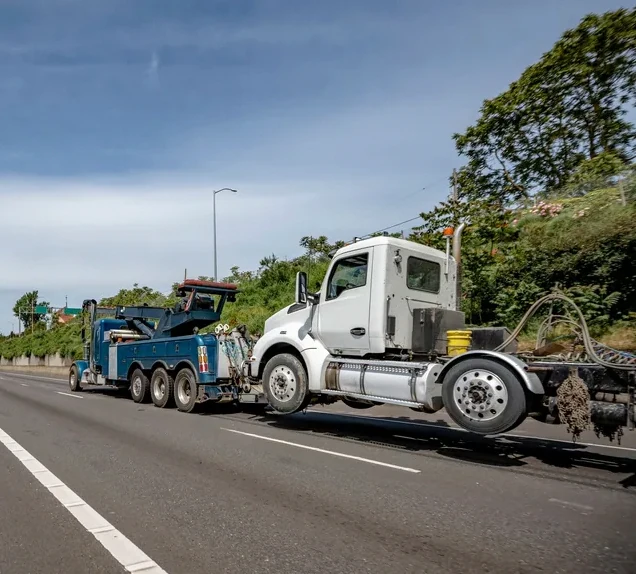
What are the signs you need Heavy Duty Towing?
You need heavy duty towing when your vehicle or equipment is too big, heavy, or stuck for a standard tow truck. Think semi trucks, dump trucks, buses, heavy construction gear, or anything over 10,000 pounds that can't move on its own.
In Birmingham, you see heavy duty towing on I-65 near the downtown split, on 459 around the Liberty Park exits, and on 280 past the Summit. A broken down 18-wheeler blocking two lanes isn't something a flatbed from a local garage can handle. It takes a rotator or a heavy wrecker with enough winch power to pull a loaded trailer up a grade.
Most homeowners don't own a semi truck, but you might own a skid steer, a backhoe, a large RV, or a dump trailer. If that equipment breaks down on your property or on a job site, you call heavy duty towing. Same deal if you're hauling a heavy load and the truck itself gives out.
The key difference is weight and configuration. Standard towing handles cars, SUVs, and light pickups up to about 10,000 pounds. Heavy duty towing covers everything above that, often up to 80,000 pounds or more. The equipment is different: heavy wreckers have multiple winches, air brakes, and the ability to lift a loaded trailer without damaging it.
If your vehicle or equipment is disabled and weighs more than a typical F-250, you need heavy duty towing. Don't let a regular tow truck driver tell you they can handle it. They might get it hooked up, but they risk breaking their own truck or your equipment on the way to the shop.
The warning signs to watch for
Watch for unusual noises, visible fluid leaks, dashboard warning lights, and any loss of power or braking. If you're driving a heavy vehicle and something feels off, it's better to pull over early than to break down in a bad spot.
A grinding or whining noise from the transmission or differential is a big one. In a heavy truck, that sound means metal on metal inside a gearbox that costs thousands to rebuild. If you hear it, stop driving and call for heavy duty towing before the transmission locks up completely.
Fluid leaks under a heavy vehicle are different from a car. A puddle of oil from a semi could be a quart or five gallons. If you see red fluid (transmission or power steering), green or orange (coolant), or thick black oil, don't start the engine. That leak might be from a line that runs dry in half a mile, and then you're stuck on the interstate with a seized engine.
Dashboard warning lights in a heavy truck mean something specific. The check engine light on a Cummins or Detroit Diesel is tied to emissions, fuel system, or engine sensors. If the light stays on and the truck starts losing power, you're not going to make it to the shop. Pull over and call for heavy duty towing.
Loss of braking is the most serious sign. If you feel the brake pedal go soft or the truck pulls hard to one side when you brake, stop immediately. Air brake systems can fail suddenly. Heavy duty towing can winch a truck with locked brakes onto a trailer, but you don't want to be the one trying to stop that truck on a downhill grade.
Any vibration that gets worse with speed is another sign. In a heavy vehicle, a bad u-joint or a separated driveshaft can cause a vibration that shakes the whole cab. If you feel that, pull over and shut it down. A driveshaft that comes loose at highway speed can tear through the floorboard or cause a wreck.
What causes these problems in Birmingham
Birmingham's hills, heat, heavy traffic, and rough road conditions put extra stress on heavy vehicles. The combination of steep grades, stop-and-go traffic on 65 and 280, and summer temperatures above 90 degrees can push any engine or transmission past its limits.
The hills around Birmingham are no joke. Coming down 65 from Fultondale into the city, or climbing 459 up toward Liberty Park, those grades put constant load on brakes and transmissions. A truck that's already worn can overheat on a long downhill. Brake fade is real, and it's why you see so many runaway truck ramps on the interstates around here.
Summer heat in Birmingham regularly hits the mid-90s with high humidity. That's hard on cooling systems. A heavy truck working in that heat, especially in stop-and-go traffic, can overheat even if everything is working right. If the radiator has a small leak or the fan clutch is weak, the engine temperature climbs fast. Once it hits the red, you're done.
Traffic on 280 and 65 is brutal during rush hour. That stop-and-go driving wears out clutches, transmissions, and brakes faster than highway driving. A truck that sits in traffic for an hour every day will have more wear than one that runs open road. That's just the reality of driving heavy in Birmingham.
Road conditions matter too. Potholes, uneven pavement, and construction zones on roads like 31 and 150 can jar a heavy vehicle's suspension and alignment. A bad pothole can break a spring or a shock mount. If you hit one hard enough, you might feel a vibration or a pull that wasn't there before. That's a sign to get it checked before it gets worse.
The construction boom around Birmingham means more heavy equipment on the road. Dump trucks, concrete mixers, and flatbeds hauling materials are everywhere. Those trucks run hard and get serviced on tight schedules. If a hydraulic line blows on a dump truck full of gravel, you need heavy duty towing to get it off the road and empty the load safely.
What happens if you ignore the signs
Ignoring warning signs in a heavy vehicle can lead to a complete breakdown, a wreck, or expensive secondary damage. A small problem that costs a few hundred to fix can turn into a several-thousand-dollar repair if you keep driving.
A transmission that's slipping or making noise will eventually fail completely. When it goes, it can take the torque converter, the driveshaft, and even the engine with it. A transmission rebuild on a heavy truck runs several thousand dollars. If you had called for heavy duty towing when the noise started, you might have saved the transmission and only needed a fluid change or a sensor.
Brake failure on a heavy vehicle is dangerous for everyone on the road. If you ignore a soft pedal or a pull, you could lose braking entirely on a downhill grade. That's how trucks end up in the median or through a guardrail. Heavy duty towing can recover a wrecked truck, but it's a lot cheaper to tow a truck with bad brakes than to replace a truck that's been totaled.
Overheating an engine can warp the cylinder heads or crack the block. If you see the temperature gauge climbing and keep driving, you're cooking the engine. A head gasket replacement on a heavy diesel can cost five figures. If you shut it down and call for heavy duty towing, you might only need a new thermostat or a radiator hose.
A vibration that gets worse can lead to a driveshaft failure. If the driveshaft comes loose at speed, it can whip around and damage the fuel tank, air lines, or brake lines. That can cause a fire or a loss of braking. Heavy duty towing can get the truck to a shop, but the repair bill for a driveshaft and the parts it broke is much higher than a simple u-joint replacement.
Ignoring dashboard lights can void warranties or lead to fines. If your truck's check engine light is on because of an emissions issue, and you keep driving, you could get pulled over by the Alabama Department of Environmental Management or the Highway Patrol. That ticket can be expensive, and you'll still need heavy duty towing to get the truck to a repair shop that can work on emissions systems.
Common questions about Heavy Duty Towing warning signs
Need heavy duty towing in Birmingham? Get a free estimate today.
📞 256-669-8032